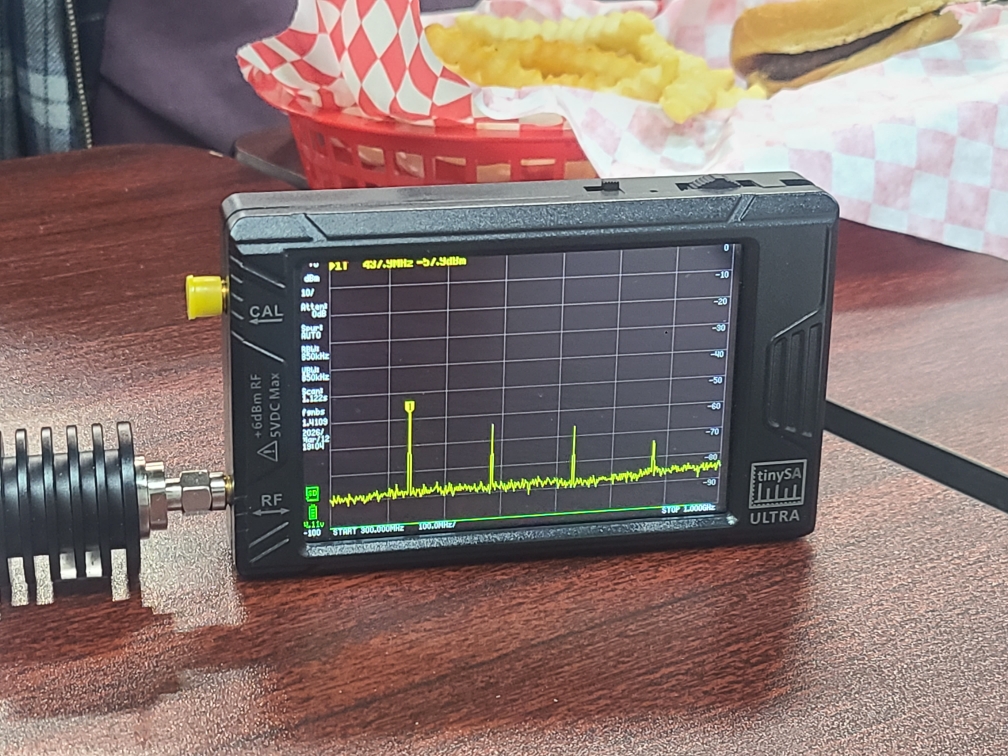
We were going to compare RX sensitivity on Chinese H/Ts, but instead, we spent most of the hour measuring TX output and using a Spectrum Analyzer (Tiny SA on Ebay for $68) to check for spurious output. Shown above is an anomaly, second, third, and fourth harmonics that weren’t there.
Two Baofeng UV5Rs (the x3 model) measured 5.3 and 5.4 Watts out on 220. That’s good. They were bought about a year ago on EBay. Deb and Sam, DBE and BJR, both had Baofeng UV25s that output at stated ratings.
Every transmitter has a Low Pass filter on the output to restrict spurious at higher freqs. FCC spec is a 40 dB reduction. Deb DBE’s TID Radio H8 showed the second harmonic at negative 50 dB, similar to Mike KI5YX’s Japanese HT at negative 53.
Rich ZQG related a story from the beginning of WWII how Leo W0GFQ and friends were able to mass produce crystals for Army tank radios, their first contract spec 60,000 xtals in a few months from a small town (Council Bluffs) in Iowa that enabled our guys to communicate faster and more easily than the opposition using tunable radios. Their secret technique was not allowed to be kept secret back then so other Americans were later able to do the same.
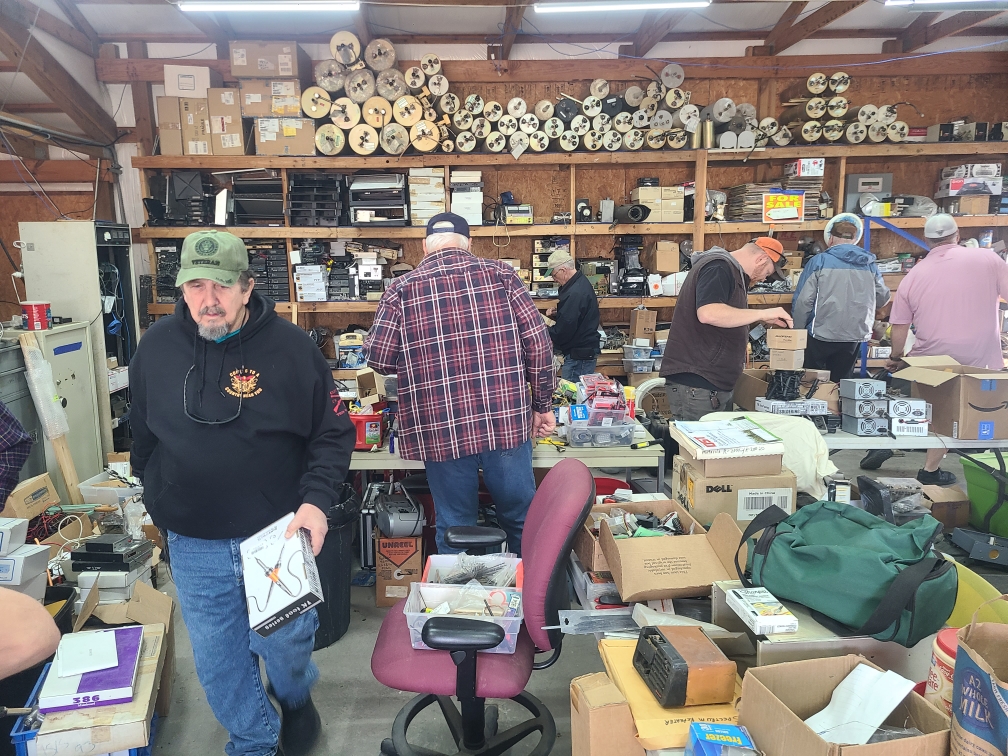
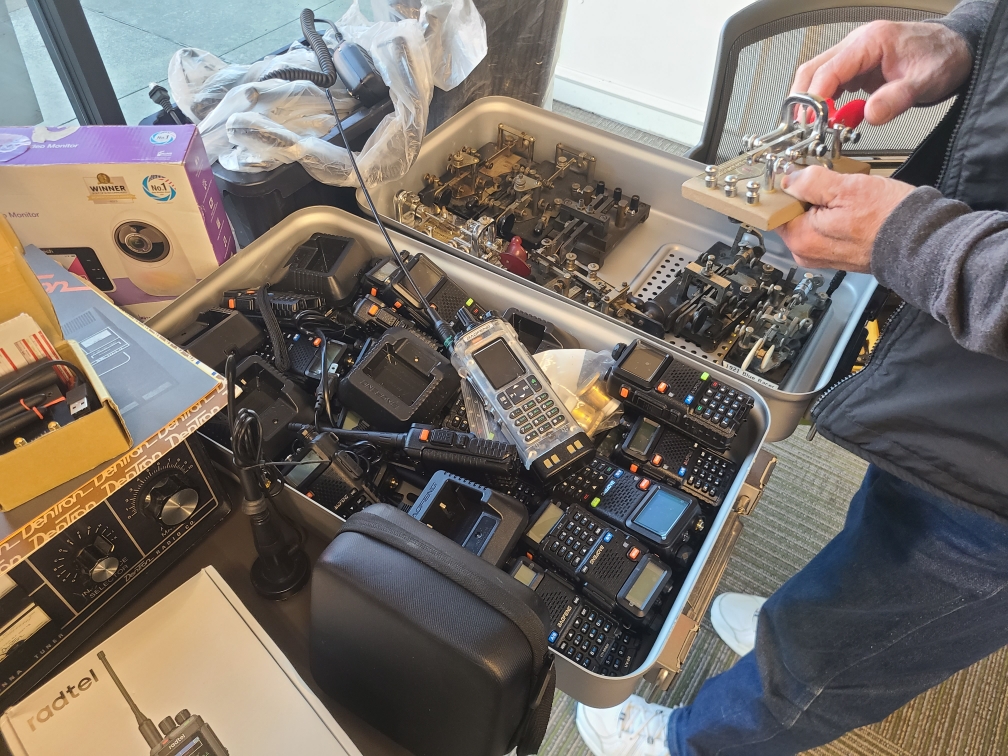
Entering the outbuilding behind the house you were greeted with an enormous Ham collection of a lifetime, and atop shelves on the far wall, dozens of 2M cavities (those round things on the top). Motorola experts would know if those stacks of radios were Maxars or Mocoms, but all the rest of us could do was look in amazement and then turn to another group of items to ask, Are these dummy loads, only to be told by an expert, No, isolators, or circulators. What’s that. There was a small stack, maybe half a dozen, of Kenwood commercial UHF mobiles. You could find familiar Ham items too such as MFJ accessories. And parts. Parts. Parts. And a scope or two. And . . . .
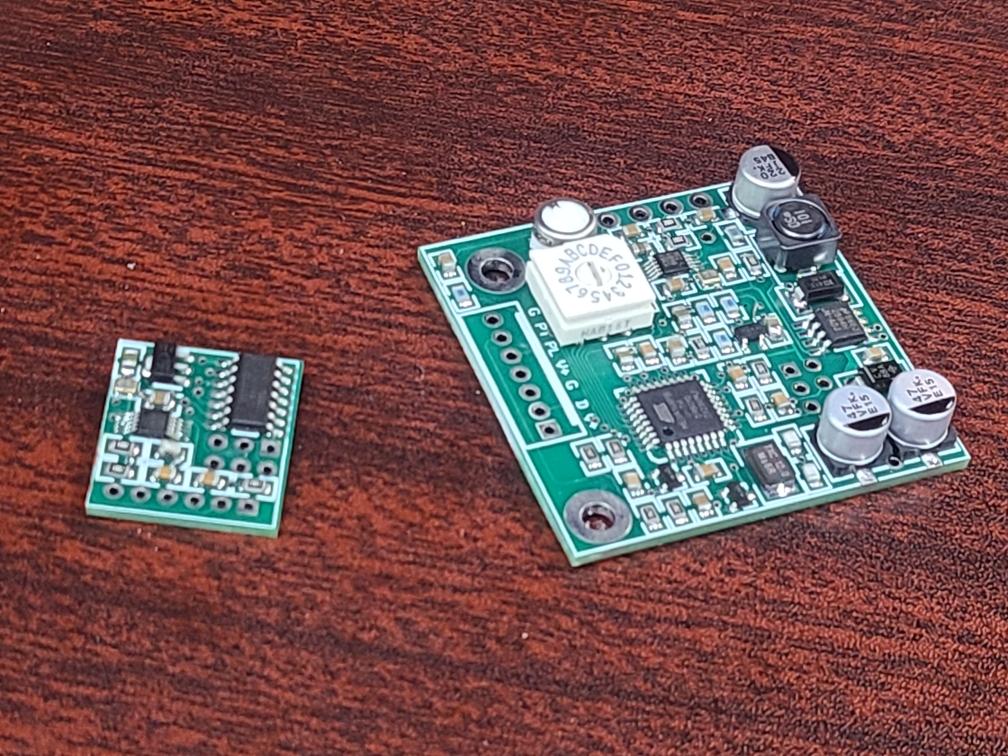
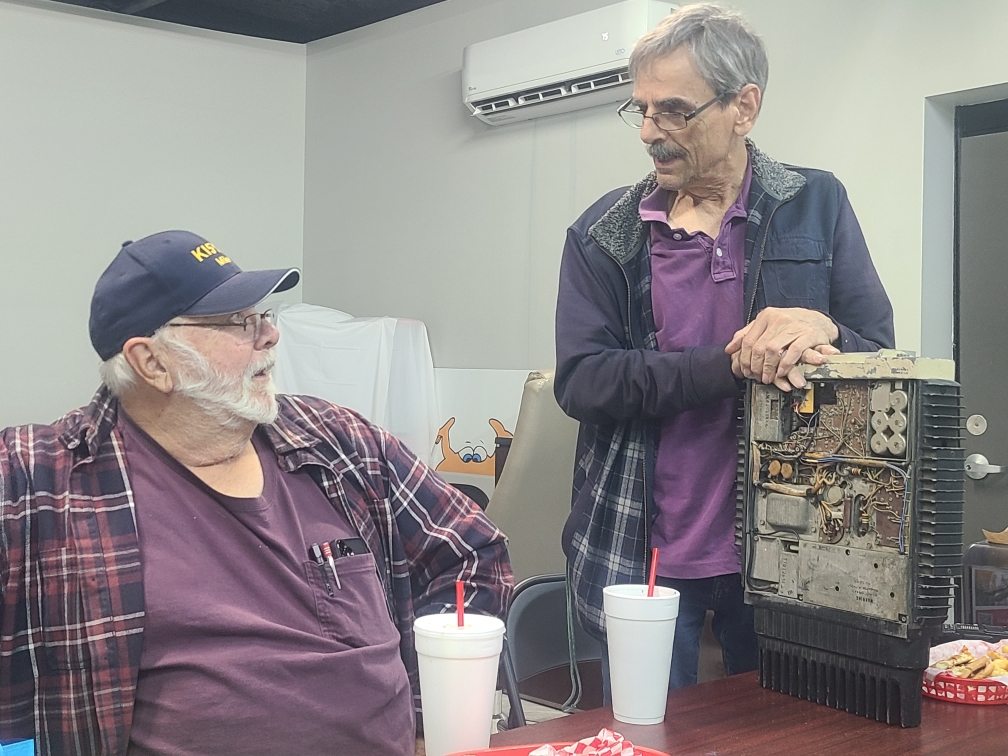
Tom KJ5NMH found a 1960s era HT-200 handie, a dual freq model (Motorolas in those days were often single, dual, or sometimes 4 freq variations) and took it home for a pittance (and put in a home made freq synthesizer – also PL tone synthesizer – that he designed himself.) (It’s the size of a crystal can, not quite an inch square.) Here are two boards he has made recently, the postage stamp size freq and tone generator that fits inside an H/T, and the slightly larger multi freq board for mobile rigs.
Kenny KJ5EKW and Rich WA5ZQG each found what appear to be new in box 220 rigs (Chinese) and are working on antennae for them. Paul WB5ANX was prominent among volunteers helping to make the sale successful. At the end of the morning, although many items were taken, the sale had made only a dent in the inventory.
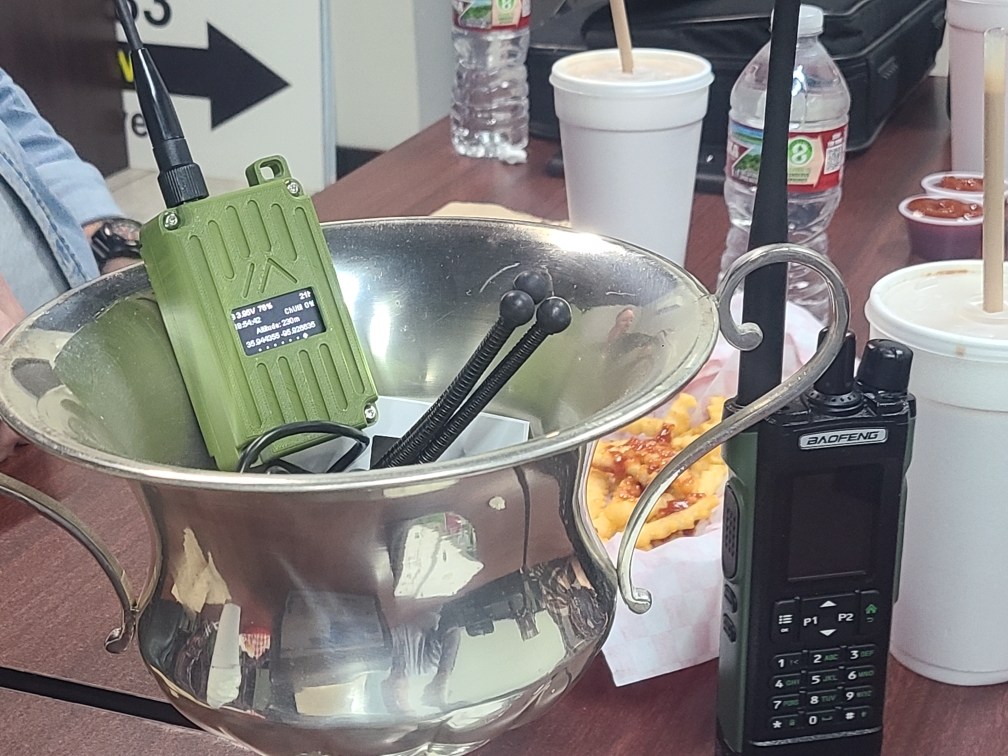
Both Mike KI5YX and Phillip KI5PFV brought their new Baofeng DMR HTs, the new DM32 model with lots of memories and larger size. In the Amateurish (see what I did there?) pic below, Mike’s 55 dollar black and green HT is on the right. Phillip spent $67 to get the clear plastic see through model (and some extra antennas and stuff).
As advertised, Mike YX also brought along his Baofeng programming computer. Kenny KJ5EKW had his new TD Radio H3 Plus (2 of them for $80) that had somehow gotten into BRICK mode. Mike tried resetting it to factory specs (didn’t work) and then reloading the firmware. The radio (in BRICK mode) didn’t respond. Lesson learned: Careful when buying radios that offer BRICK mode. Mike put a variety of 2M and 440 freqs in the other one.
Kenny EKW won the Silver Plated door prize (see pic above) although a condition of winning was to donate two bucks to another club (RSGB does not have a Treasurer).
Deb K5DBE brought her new MeshTastic Node, an 89 dollar RAK WisMesh pocket V2 with internal battery, GPS, and small LCD display. You talk to it through an App on your phone. Deb set it up herself (with guidance from Jeff AI5ME) and has been reading texts from all over town. See the pic above – the green HT thing on the left. No PTT button, and no speaker. Your PHONE.
Next mtg is Thurs 26 Febr, 7PM at Scott’s hamburgers in downtown Bixby. Left side, way in back..
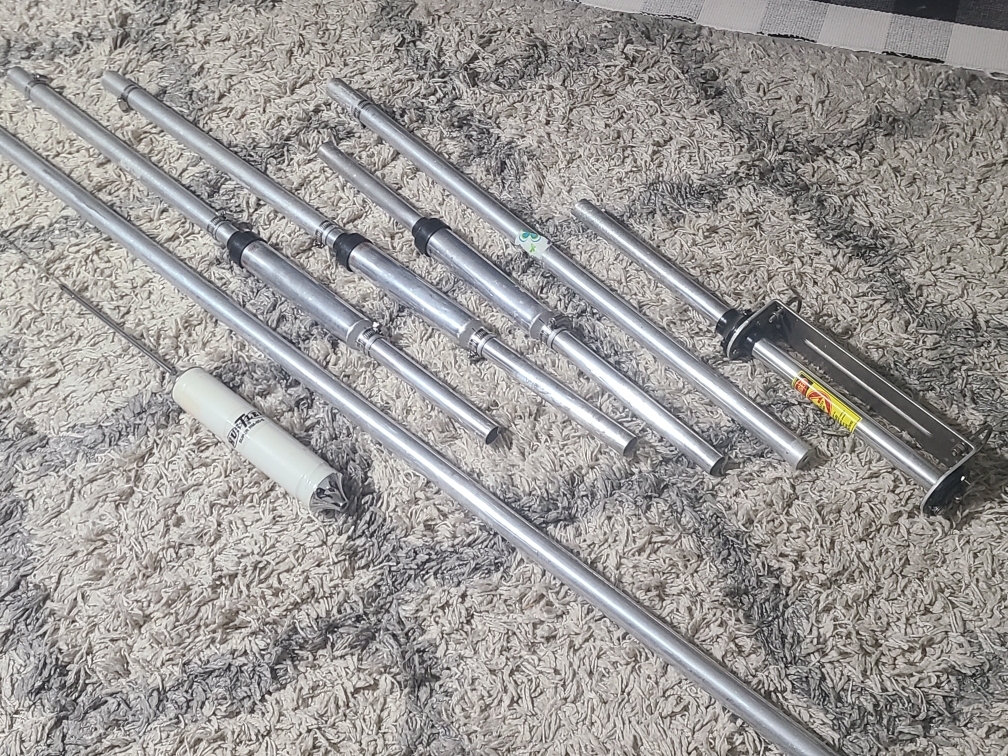
Mike KI5YX brought in a 220 J-Pole made with 3/8 in copper pipe (2/3 the length of a 2M J-Pole). The ‘U’ at the bottom was about 13 in tall, and the half wave radiator above was around 26 inches. There used to be a 220 Net on one of the 220 repeaters, but not lately.
The slightly revised meeting format allows a brief Show and Tell from each person prior to the Tech subject program. Mike held up the copper J-Pole and the rest of us had a few comments. A common concern on antennas was the advertised gain figures, often distorted by ISOTROPIC gain; ground reflection gain, or plain lies. Next mtg is on Lincoln’s BDay, Febr. 12th.
Tune in Wed and Fri on the B.A. 146.91 repeater at 7PM for the Conspiracy Net where you can talk on a variety of subjects.
Mike KI5YX: Really? That old? Tom KJ5NMH: Yeah, we weren’t even teenagers yet when this one was new. 1958. Tube finals, a 6146 driver and 6550 final, both laid down horizontal in the aluminum heat sink in back. International doesn’t make crystals any more so I added a freq synthsizer, you can see it under my fingers at the top, and a PL tone generator too. It’s also there, but so small you can’t see it in the picture. Ten (10) channels now. Big problem is there’s no hi/low power switch so it’s a hundred (110 W) and ten Watts out all the time. It’ll smoke your average mobile antenna. I got another one from the 60s that’s all transistor. Put a freq synthesizer in it too, but totally different than this one. Has a two wire serial input to the crystal socket from outside with a digital freq display.
Next mtg is 4th Thurs at Scott’s hamburgers in downtown Bixby. More on how antennas work (input impedances) and what controls gain (G5RV and OCFed not included).
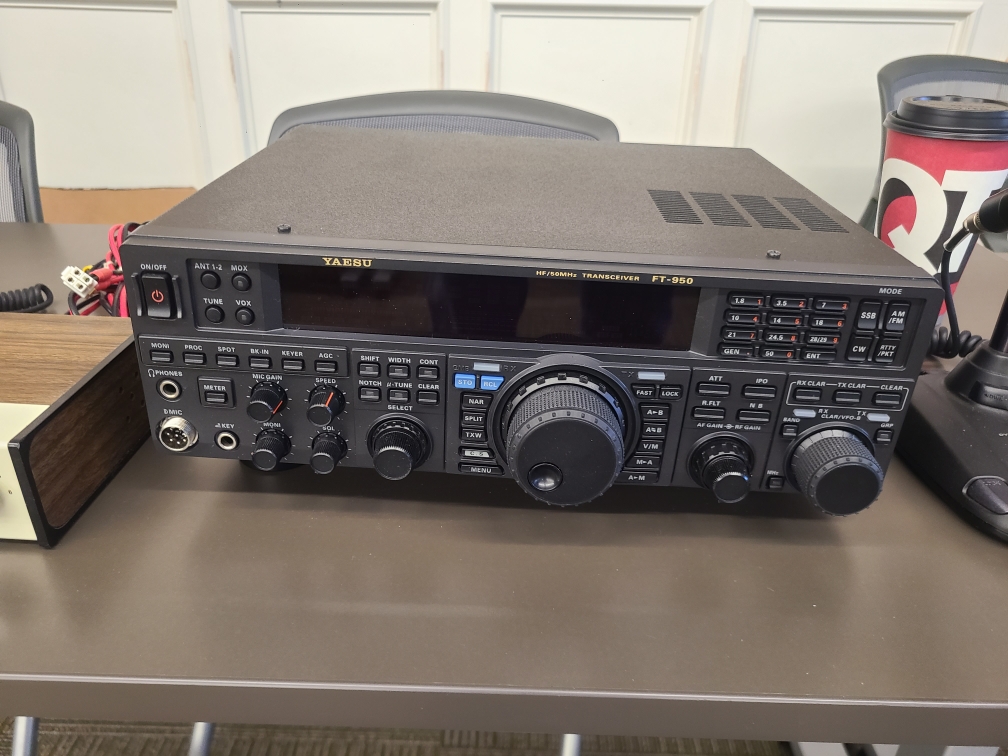
Right as you went in the door at the Henryetta Hamfest Saturday, Jason W5HP had this nice looking Yaesu 950 HF and 6M rig for which he was asking $500, not much more than a new Xiegu G90 that doesn’t have even a quarter as many buttons and knobs and runs only 20W.
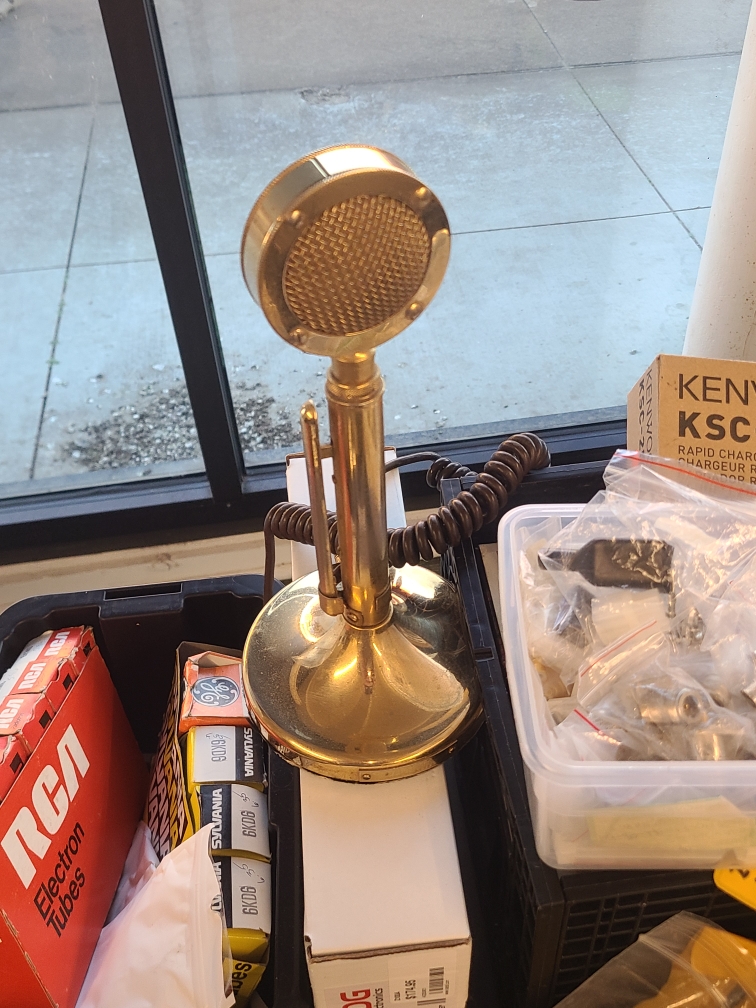
Some other interesting items included a gold plated D-104 microphone (they also had a regular chrome D-104). There was also a Yaesu 991A put back in the box marked 1 kilobuck. Wonder if you could get it for less.
They had a whole box of Vibroplex paddles. You could probably buy one and then suggest to friends that you know code really well. (Change the subject really quick after that.)
They had 28 tables and not all of them were in use. With increasing awareness and growing Ham population in the Tulsa area, this one is going to get more popular, and it’s only 42 miles from Bixby.
The Henryetta club website is (Crossroads club) CARCradio dot org.
Larry W5LQF answered the most Jeopardy game questions Thursday night and took home a 1995 Radio Amateur’s Handbook prize. Sam KJ5BJR came in 2nd and won the 1972 edition (which has a bunch of Vacuum Tube specs in the appendix). Questions (or answers) included What’s the ARL callsign, W1AW, and What’s the color code for a (very conservative) 33k resistor, Orange Orange Orange. Note: Sam BJR and XYL Debbie K5DBE brought with them a new 10W H/T and 50W dual band radio they’d won at the TARC Christmas meeting two days before.
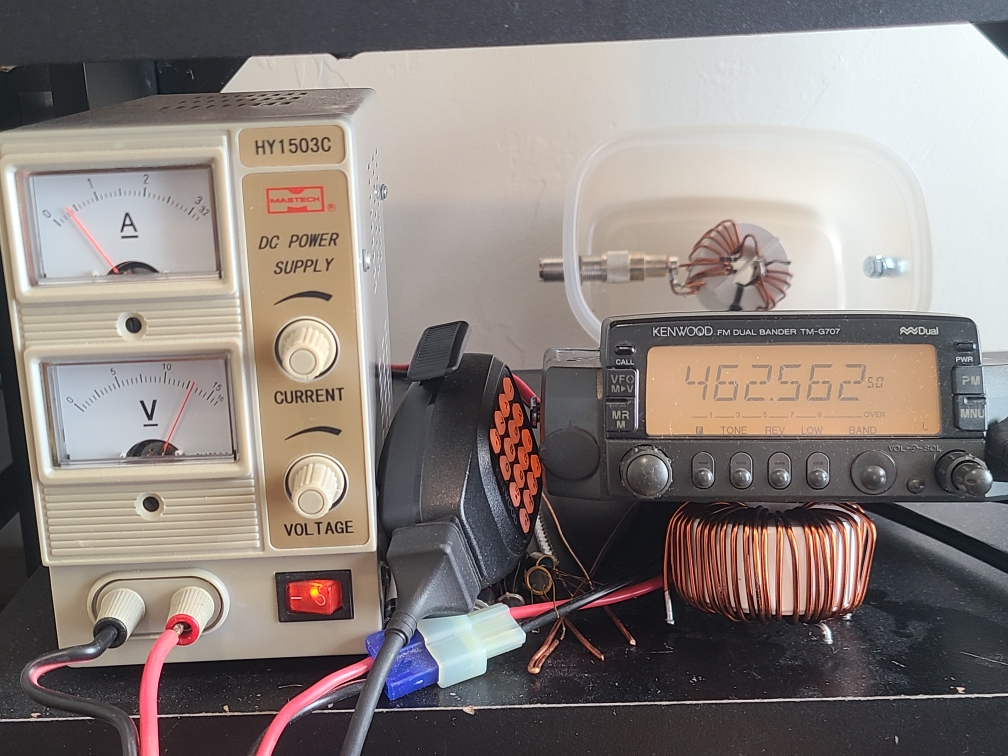
Kenny EKW’s Kenwood 7400 2M rig puts out 28W on high and 5W low power. Internal dissipation (Volts x Amps less RF output) changes from 38 Watts to 37 Watts (i. e. It gets just as hot on low power as it does on high.) We measured both input Volts and Amps and RF output Watts of an old Kenwood G-707 dual band to find it uses just over 5 Amps at full 27 Watts out on 2M, and also 5+ Amps putting out 22 Watts on UHF (and also the smae 5 Amps with only 14 Watts out on 462.5625 (that’s FRS Ch 1). No, we’re not going to use it there, just checking. At lower power levels it gets much less efficient, like a 2 Amp draw at 3W out.
Note: This Tx efficiency thing is not just some esoteric bit of information, but real life physics of like, How Many Watt Hours do I need to run my Yaesu 857 at 15 Watts of FT8 mode for six hours at 25% duty cycle in a portable operation (battery powered). Answ: A lot more than 15% of 20A (full power) with those parameters.
Before the digital rigs (mid to late 1980s and 90s) an HF rig in receive mode might use half an Amp or less. The early Kenwood 520 (had 73 transistors) with the tube heaters turned off (there was a switch to do just that) ran only 340 mA in Rx mode. My digital Kenwood 440 with a hundred memories and general coverage receiver takes 1600 mA in receive. That heavily impacts efficiency if you’re thinking POTA this weekend with a LifePo battery, and reducing power output to only 15W of FT8 mode doesn’t save as much as you’d think. Put these specs on paper (FM or 100% duty cycle mode): 100W uses 17.5 A, 50W uses 12 A, 25W takes 9.5 A, and 10W still takes 6.5 Amps. You could subtract the 2.4 A at zero output to get exact Tx efficiency, but you get the idea, a quarter of full output (17.5A) takes over half as much battery power. (Figure your duty cycle, maybe 10 to 20 % and the number of hours you want to work. Note: A brief stint might be accomplished with a much smaller LifePo than those car battery size hundred Ampere hour things bc you can use them down to near zero without severe damage, unlike a lead acid.)
Heisenberg, Schrodinger and Ohm are in a car. They get pulled over. Heisenberg is driving and the cop asks him, “Do you know how fast you were going?”
“No, but I know exactly where I am” Heisenberg replies. The cop says, “You were doing 55 in a 35.” Heisenberg throws up his hands and shouts, “Great! Now I’m lost!”
The cop thinks this is suspicious and orders him to pop open the trunk. He checks it out and says, “Do you know you have a dead cat back here?”
“We do now, darn you!” shouts Schrodinger. The cop moves to arrest them. Ohm resists.
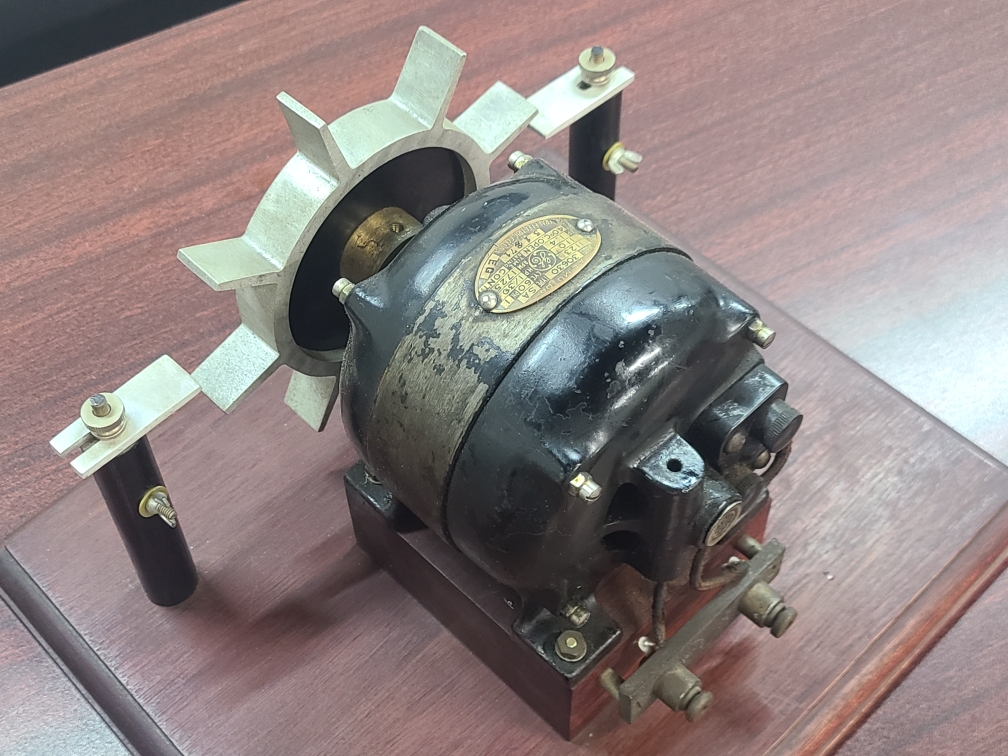
Earl WB5UUW from Broken Arrow, brought in this key component of an All Band Rotary Spark morse code transmitter from the WWI era, a motor driven spark gap. Together with a huge power supply (takes 2 men and a boy to lift), CW key, and aerial wires connected to the two spark posts shown, it’ll run about 10 kW and allow you to make contacts perhaps hundreds of miles distant on a good night. (You caught the part about being an All Band transmitter.)
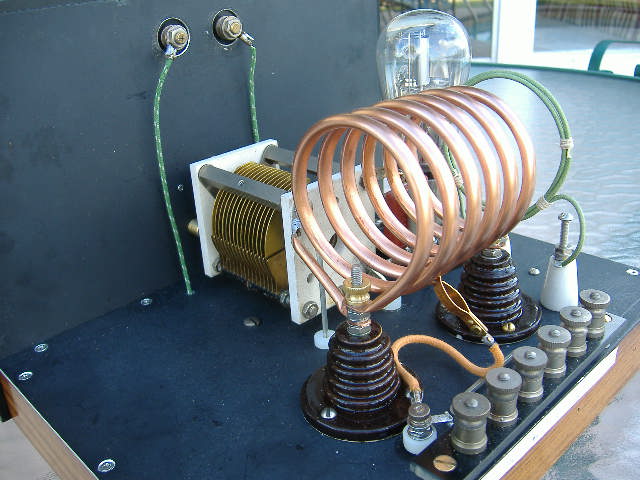
Parker W1YG recreated a tube type Hartley Oscillator single tube transmitter as used in the 1920s and we had several pics of it at the meeting. Using a sine wave oscillator on a single frequency meant that several guys could get on the air without interfering with each other, a big improvement over wide band spark transmitters.
We also inspected an hourly chart of a 100Ah LifePo battery charging voltage. LifePos both charge and discharge in the range of 13.0 to 13.5 V which should make your 12V rig very happy. Charging is 99% complete at 13.6 V so it’s possible to use a charger meant for lead acid batteries (typically ending at 13.8 to 14V) and not have to buy a separate (and expensive) charger specific to LifePos (which usually have an internal Battery Management System that CUTS OFF if you try to charge them much over 14.4).
Rich ZQG recently bought a Palomar Engineers OCF 4010 antenna and showed the SWR chart for several bands. It wasn’t as good as claimed (usable on Every Band 40 thru 6M) probably because it’s only up 15 ft with one end drooping down to 5 ft the last 20 ft of antenna. More later. Here’s the more: Got it up 8 ft at the ends, but still only 15′ at the 4:1 balun. Tunes real good (low SWR on 40 and 15) and OK on 20 and 10, tunable or even straight through at like, 2.1 SWR or a little more. Chart says it’s supposed to be OK on the WARC bands (30, 17, and 12M) but you really need a tuner there. Six (6M) meters (SWR 2.7) is usable with a tuner.
Matt Damon starred in the movie The Martian, and was rescued partly due to a spaceship returning from Mars using a SlingShot Orbit around Earth to go back and pick him up. We discussed various orbital parameters and requirements, noting the Space Shuttle uses only 2 stages, solid boosters and the shuttle itself with an Enourmous fuel tank (as opposed to the conventional 3 stage rocket) to attain orbital velocity. See you at the next meeting 11 December. (4th Thurs canx bc Thanksgiving)
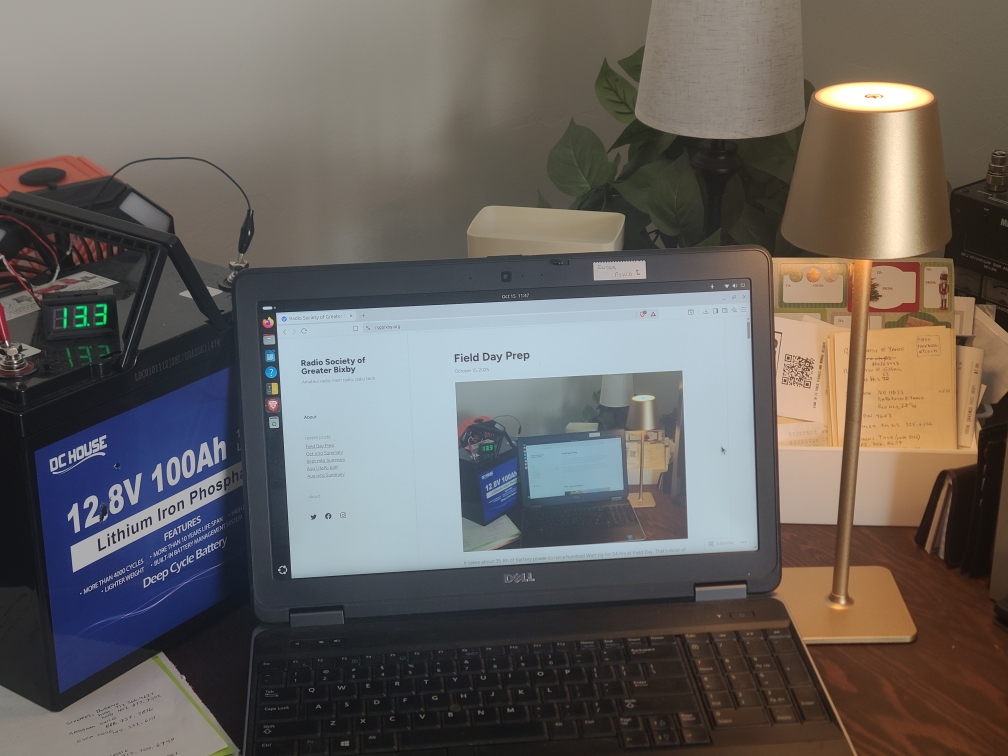
It takes about 35 Ah of battery power to run a hundred Watt rig for 24 hrs at Field Day. That’s most of the ‘usable’ capacity (50%) of a 100 Ah lead acid battery, but only 35 of those new hundred Ah LifePo batteries, and you can buy those used on EBay for just over $100. (LifePo batts are good for thousands of cycles over 10 years so you’re unlikely to wear out a used one.)
Another nice item to have overnight at FDay is a battery powered light. Again, EBay has some nice rechargeable table lamps for around twenty bucks. They’ll run for hours and charge with a phone charger type cable. (Two for $40. Let the XYL have one in the living room. Oh yeah, and that’s how you sell the idea to her, lights on when the power goes out.)
LifePos aren’t the ones that catch fire and blow up. That’s Lithium Ion like your phone, that living room light above, and Teslas. LifePos may fail, but they usually don’t catch fire and don’t emit clouds of toxic smoke. Also, the 12V one as above remain in the 13 to 13.5 range almost their entire discharge curve, so your rig will put out normal full power unlike with a lead acid that gets into the elevens half way down.
Hey, uh, what’s with that pic above? Is it done, like, with mirrors?
 Radio Society of Greater Bixby