According to some, QST magazine used to use the abbreviation MC for Morse Code until one day the kid they had in the print room dropped one of the page blocks, spilling most of the type on the floor. He got it all back together, but wasn’t a Ham at the time and put those two letters back in upside down and backwards so that it read ‘CW’. The powers that be, not wanting to admit a headquarters mistake, (and good at finding words to fit seemingly unrelated letters) came up with the electronic sounding Continuous Wave (Yeah, everybody knows Morse is not continuous.) and that’s how it’s been since. Trivia Q. What year did they start printing QST. Was it 1907, 1915, 1926, or 1935.
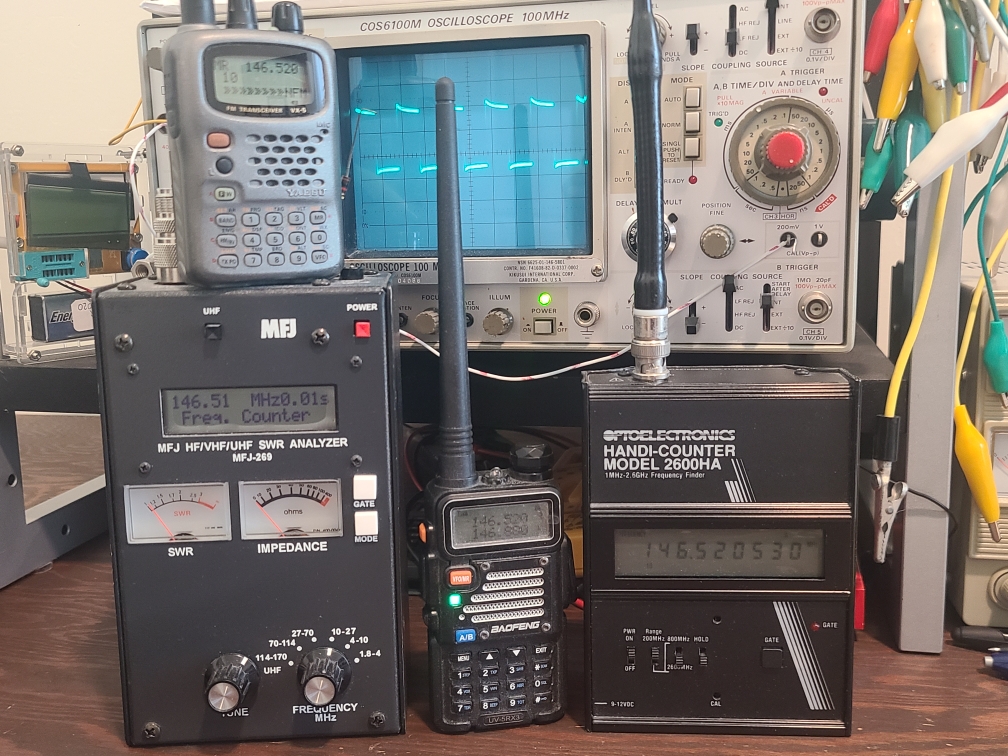
Using a freq counter to measure several newish Chinese H/Ts and one decades old Yaesu VX-5 H/T, they were all 150 to 200 cyles high from 146.52 Simplex. (146.520150) We thus concluded the calibrated freq counter was probably off about 150 to 200 cycles at 2M (one part per million or .0001%) The MFJ SWR Analyzer, itself about a decade old (and not since calibrated) was way off showing all the equipment over 1 kc low. Did you know an MFJ has a built in freq counter?
We got a little history of transistors, invented by Dr William Shockley and others in 1947. Xistor type numbers begin with 2N because there are two (2) junctions. Similarly, diodes start with 1N with only one PN junction. The type 2N2222 not only has a great number but also is a good substitute for many other types. You can use two of them to make a QRP transmitter (look up Tuna Two) on 40M that only runs a couple hundred milliwatts. Type 2N2219 is the same exact thing in a slightly larger (higher power) case. Answ: DeForest invented the Audion amplifying tube in 1907. Superhet radio receiver system started about 1926, and by 1935 superhet receivers were about as good as today.
 Radio Society of Greater Bixby
Leave a comment