Larry W5LQF answered the most Jeopardy game questions Thursday night and took home a 1995 Radio Amateur’s Handbook prize. Sam KJ5BJR came in 2nd and won the 1972 edition (which has a bunch of Vacuum Tube specs in the appendix). Questions (or answers) included What’s the ARL callsign, W1AW, and What’s the color code for a (very conservative) 33k resistor, Orange Orange Orange. Note: Sam BJR and XYL Debbie K5DBE brought with them a new 10W H/T and 50W dual band radio they’d won at the TARC Christmas meeting two days before.
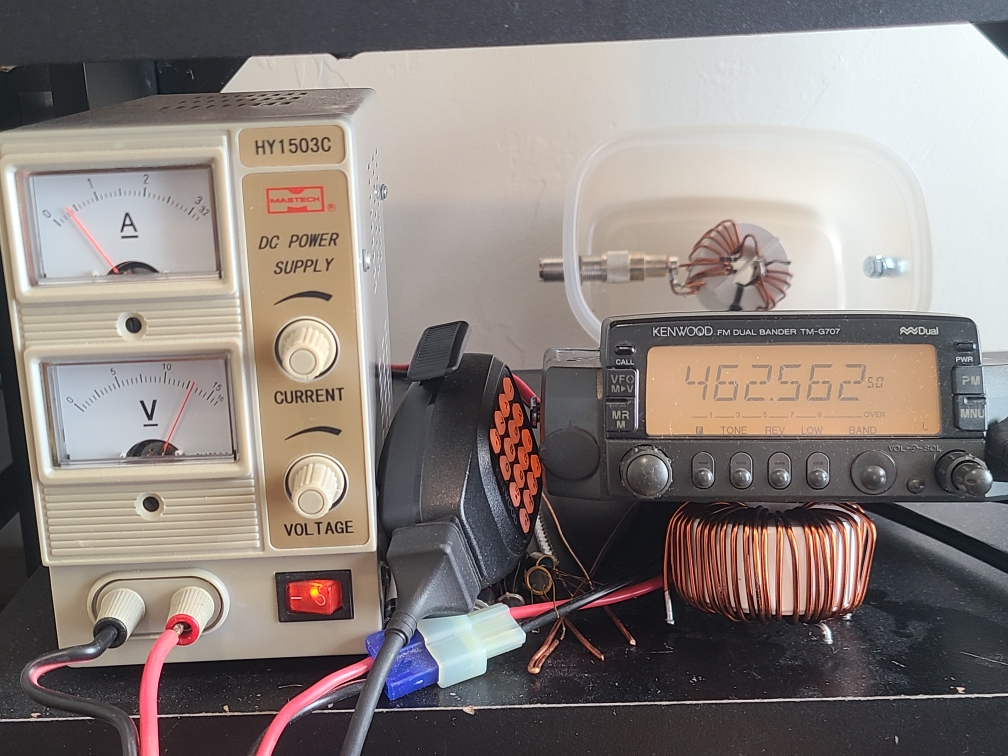
Kenny EKW’s Kenwood 7400 2M rig puts out 28W on high and 5W low power. Internal dissipation (Volts x Amps less RF output) changes from 38 Watts to 37 Watts (i. e. It gets just as hot on low power as it does on high.) We measured both input Volts and Amps and RF output Watts of an old Kenwood G-707 dual band to find it uses just over 5 Amps at full 27 Watts out on 2M, and also 5+ Amps putting out 22 Watts on UHF (and also the smae 5 Amps with only 14 Watts out on 462.5625 (that’s FRS Ch 1). No, we’re not going to use it there, just checking. At lower power levels it gets much less efficient, like a 2 Amp draw at 3W out.
Note: This Tx efficiency thing is not just some esoteric bit of information, but real life physics of like, How Many Watt Hours do I need to run my Yaesu 857 at 15 Watts of FT8 mode for six hours at 25% duty cycle in a portable operation (battery powered). Answ: A lot more than 15% of 20A (full power) with those parameters.
Before the digital rigs (mid to late 1980s and 90s) an HF rig in receive mode might use half an Amp or less. The early Kenwood 520 (had 73 transistors) with the tube heaters turned off (there was a switch to do just that) ran only 340 mA in Rx mode. My digital Kenwood 440 with a hundred memories and general coverage receiver takes 1600 mA in receive. That heavily impacts efficiency if you’re thinking POTA this weekend with a LifePo battery, and reducing power output to only 15W of FT8 mode doesn’t save as much as you’d think. Put these specs on paper (FM or 100% duty cycle mode): 100W uses 17.5 A, 50W uses 12 A, 25W takes 9.5 A, and 10W still takes 6.5 Amps. You could subtract the 2.4 A at zero output to get exact Tx efficiency, but you get the idea, a quarter of full output (17.5A) takes over half as much battery power. (Figure your duty cycle, maybe 10 to 20 % and the number of hours you want to work. Note: A brief stint might be accomplished with a much smaller LifePo than those car battery size hundred Ampere hour things bc you can use them down to near zero without severe damage, unlike a lead acid.)
 Radio Society of Greater Bixby
Leave a comment