• A hundred years ago most Hams had transitioned from Spark transmitters to the new Vacuum Tubes which, through Feedback, were able to generate just a single frequency output thus allowing more than one guy at a time to transmit without having to decipher the slightly different tonal quality of a spark to determine who it was transmitting. (The ‘T’ part of the RST signal reporting system.) Tubes allowed amplification of weak signals, and with the recently invented superheterodyne receiver system, up to and over 100 dB of receiver total gain by changing (heterodyning) the frequency of the signal several times.

    Transistors (William Shockley at Bell Labs in 1947) allowed the same kind of amplification advantage without all the heat and high voltages that make tubes work. They didn’t take over right away, portable AM radio receivers in the 1950s, and some functions like the Noise Blanker in the Galaxy V five band transceiver in 1964, but by the early 1970s the Kenwood 520 five band HF transceiver had 73 of them, everything but the 12BY7 driver and two S-2001 final tubes (similar to the thirty five Watt 6146 tube).

    Transistors are little, and it’s really hard to make 2 batches of them come out with same specs so the gain of a specific type can vary a lot. Example: hFE gain of a 2N2222 runs from 100 to 300. If the batch comes out really bad they call ’em 2N2221s with a gain of 40 to 120.

    Differential amplifiers consist of 2 transistors (facing each other) and are really useful, a favourite circuit used in power supplies comparing half the 12V output to a 6V Zener regulating diode. It’s best when the 2 transistors have similar gains so (now) the differential is part of an Integrated Circuit IC where ALL the transistors come out with the Same Range of Gain (and the differential is thus balanced).

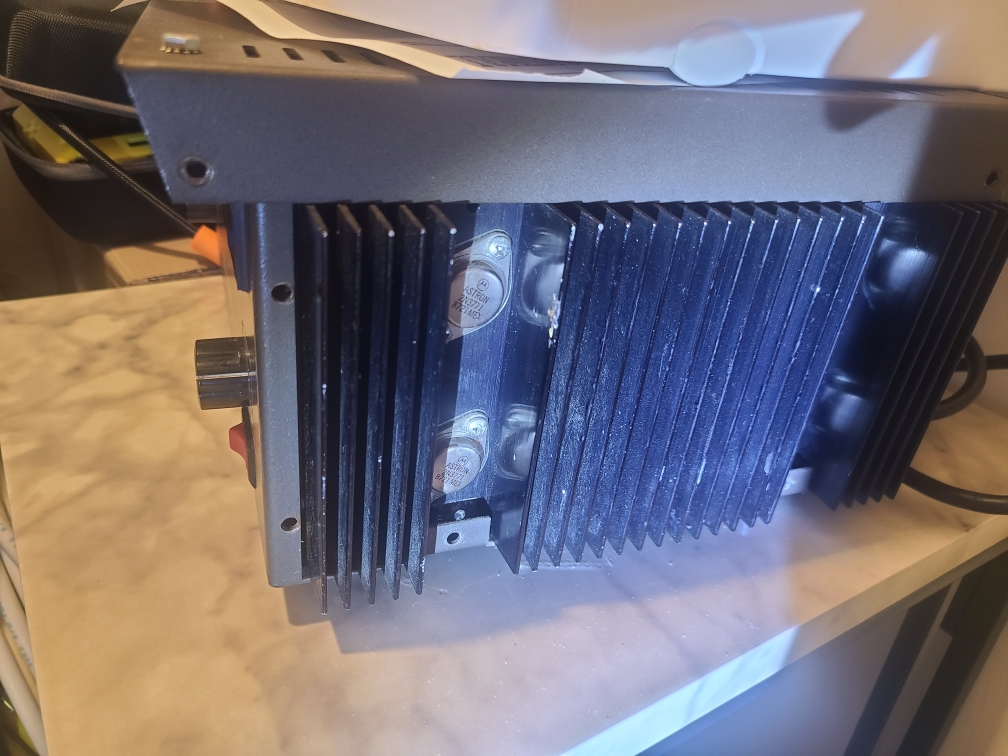
    Transistors are still little when they handle lots of Amps, but they put them in different cases to get rid of all the heat. The 2N2222 can only handle milliwatts, or up to Half A Watt if you’re bold. The same chip in a larger (TO-5) case is called a 2N2219 and runs a maximum of 0.8 Watts. The Astron favourite 2N3771 comes in a diamond shape TO-3 case that (when well attached to a big piece of aluminum) can handle well over a hundred Watts. Calculate how an Astron 35 running at max with 21 Volts input and 14 out, divides the heat among only 4 transistors. Seven Volts across the transistors (21 minus 14) times the 35 Amps equals, uh, two hundred plus, exactly 245 Watts. Divided among the 4 transistors it’s 61 Watts or so, well within the 150 Watt rating each. Note: The Astron 35 says it’ll do 15 or 20 Amps continuous. No, it won’t. It doesn’t have a fan. Prop up a little five inch computer fan in back of it and you can do that, like, for repeater use.

    We won’t meet again until 2nd Thursday in November, the 13th, so there’s plenty of time to go home and look in the back of our power supplies to see if it’s 2N3771s like on an Astron, or something else. The switcher power supplies use an even more expensive type, but you have to open the case to see what kind they are. (They run at like, 40 kc or more into a ferrite transformer, not just responding to 120 cycle ripple.)

    DETAIL: The pic shows right side of an Astron 50. It’s covered, both sides and back, with heat sinks. What’s the Date Code on the 3771 (YrWk). So how old is that 50?
  • According to some, QST magazine used to use the abbreviation MC for Morse Code until one day the kid they had in the print room dropped one of the page blocks, spilling most of the type on the floor. He got it all back together, but wasn’t a Ham at the time and put those two letters back in upside down and backwards so that it read ‘CW’. The powers that be, not wanting to admit a headquarters mistake, (and good at finding words to fit seemingly unrelated letters) came up with the electronic sounding Continuous Wave (Yeah, everybody knows Morse is not continuous.) and that’s how it’s been since. Trivia Q. What year did they start printing QST. Was it 1907, 1915, 1926, or 1935.

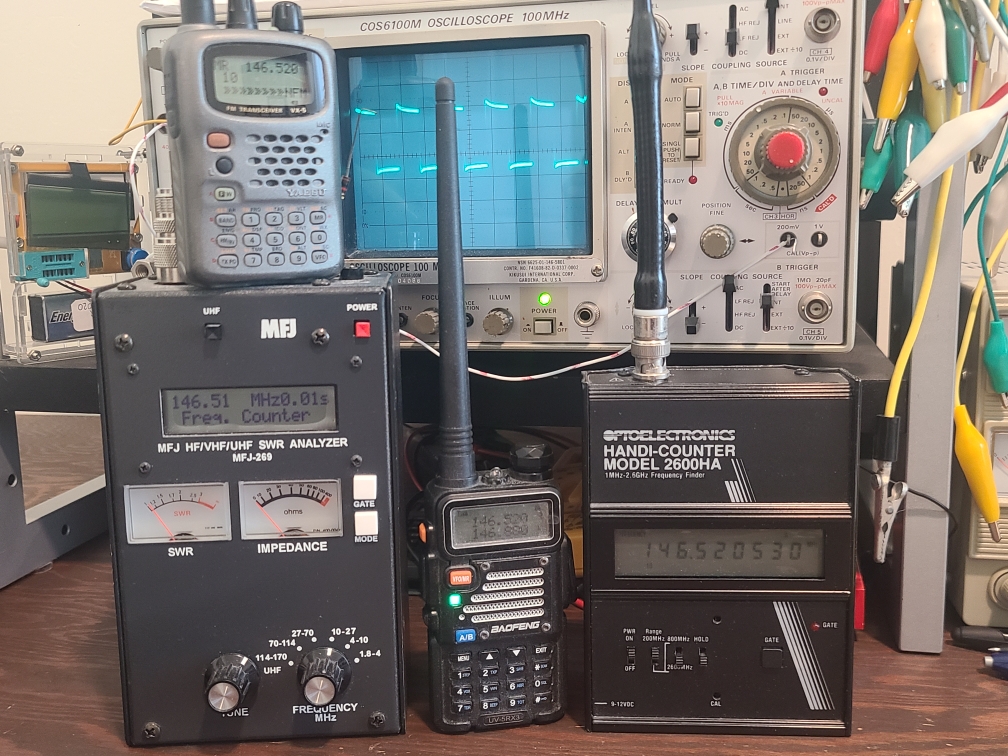
    Using a freq counter to measure several newish Chinese H/Ts and one decades old Yaesu VX-5 H/T, they were all 150 to 200 cyles high from 146.52 Simplex. (146.520150) We thus concluded the calibrated freq counter was probably off about 150 to 200 cycles at 2M (one part per million or .0001%) The MFJ SWR Analyzer, itself about a decade old (and not since calibrated) was way off showing all the equipment over 1 kc low. Did you know an MFJ has a built in freq counter?

    We got a little history of transistors, invented by Dr William Shockley and others in 1947. Xistor type numbers begin with 2N because there are two (2) junctions. Similarly, diodes start with 1N with only one PN junction. The type 2N2222 not only has a great number but also is a good substitute for many other types. You can use two of them to make a QRP transmitter (look up Tuna Two) on 40M that only runs a couple hundred milliwatts. Type 2N2219 is the same exact thing in a slightly larger (higher power) case. Answ: DeForest invented the Audion amplifying tube in 1907. Superhet radio receiver system started about 1926, and by 1935 superhet receivers were about as good as today.

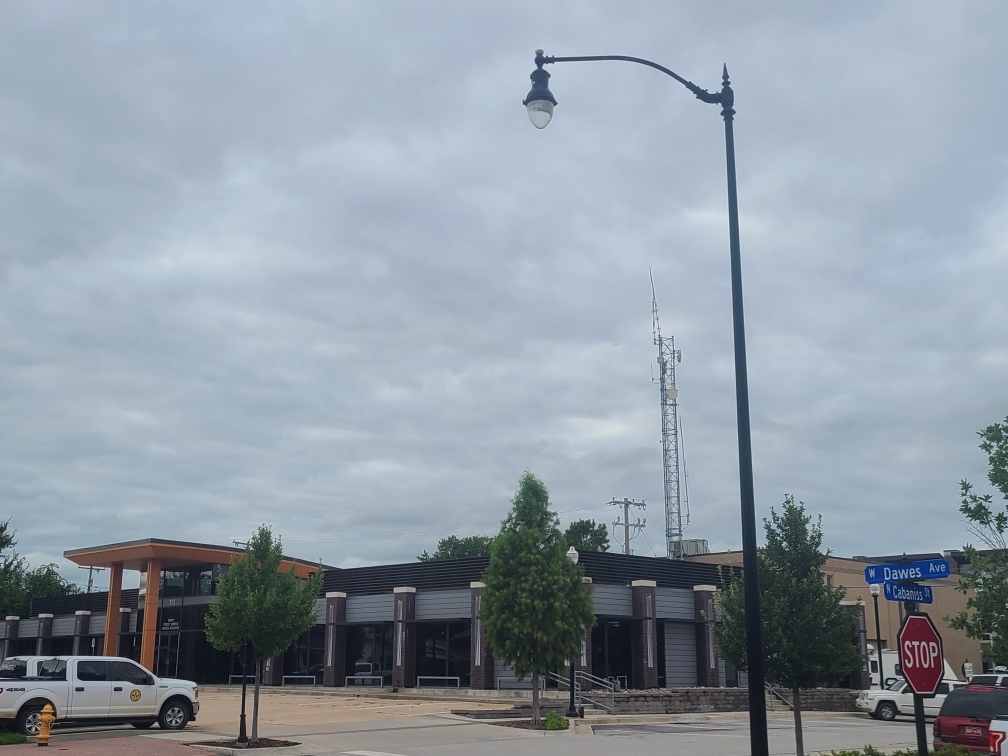
  • Mark KJ5JVV brought his five hundred dollar Fluke model 177 meter and verified our previous readings on a 100 Ah LifePo made with our seven dollar Harbor Freight digital meters, having found our place between the arches in the center of town and the Bixby Police antenna (see pic above) and then went across the street to Scott’s hamburgers on the North side of Dawes St, verifying that the LifePo was down to 13.15 Volts as a result of being hooked up to a Yaesu 991 for a day and a half trying to see how long the 100Ah would last (13.15 suggests it’s down to under 30%).

    Note: Sentence above will not be entered in the Bulwer – Lytton contest for run on introductory sentences. It’s just practice.

    Excluding a 57 yr old analog and a faded red Harbor Freight digital with visibly changing readings, all the meters we had (a Fluke and several Hbr/Frts) had voltage readings spanning just a 0.7 % range with the Fluke reading centered in that range (so we can expect a reading of 14.4 on a fully charged LifePo to be accurate). The 11 mA current measurements ranged 3% with Mark JVV’s Fluke 177 way off, nearly 30% low at 9.21 mA. We surmised the cause was a previous owner greatly exceeding the 400 mA stated max range which damaged the internal shunt (and likely the reason Mark got the great bargain. Hey Mark, when measuring mA with that meter, figure it’s 30% low).

    The other measurements, a fifty year old 1k resistor with a gold band (that’d aged up to 1090) and the 122 Volt AC line voltage, all came out within a percent – great considering Harbor Freight says they’re only accurate to 1 pt 2 percent. The Hbr/Frts jumped around on the 120 AC while the Fluke seemed to show an ‘average’ reading that didn’t jump around so much.

    ADDENDUM: Kenny KJ5EKW offered his Fluke 117 (which he uses professionally measuring black, white, and green wires) and it verified the 11mA current reading that our used $500 Fluke model 177 had erroneously suggested was 9.21 mA.

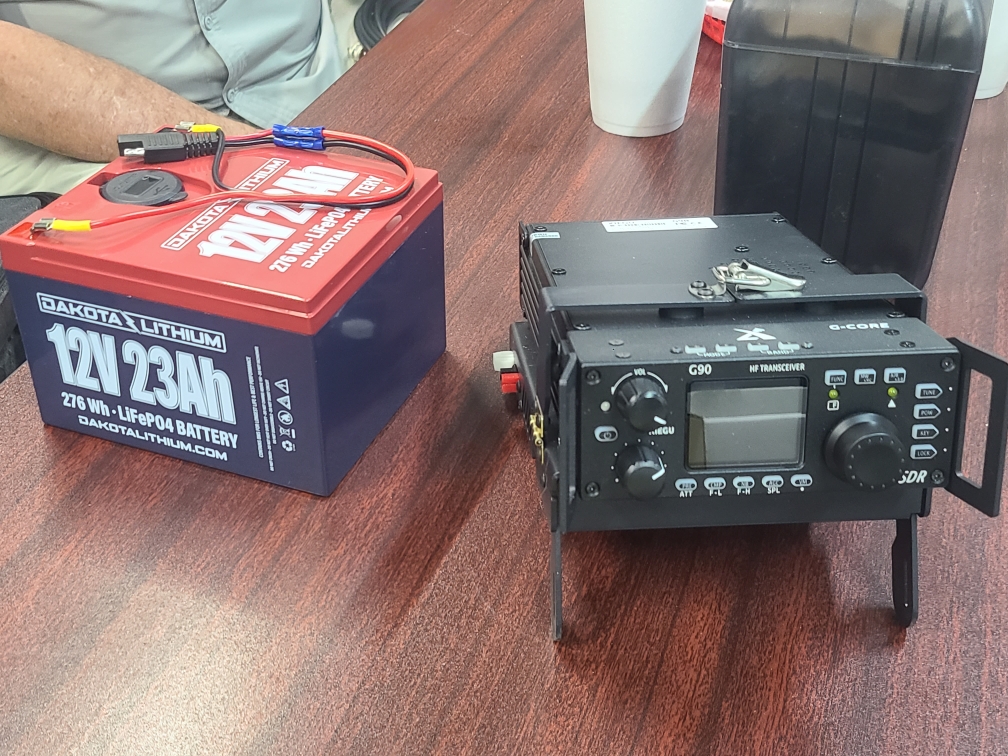
  • Jim K5LE won the prize for most miles traveled from his QTH 8 miles North of Pryor OK, choosing a 12V 2A wall plug over a 1A USB charger. Brad WA5PSA chose the USB charger for bringing the most meters. Scott’s hamburgers welcomed us into the back ‘Party’ room set up with rows of deluxe wood grain Flea MKt tables and chairs where we displayed several LifePo batteries; some other items to be measured, and a Xiegu G90 20W HF rig brought by Deb K5DBE and Sam KJ5BJR.

    Several digital Voltmeters agreed the 100Ah LifePo featured was right around 13.35V right then, (they tend to vary from 13 to 13.5 just sitting there depending on remaining charge). An old Radio Shack analog meter (with a needle and a scale) said 12.5 which is why you use a digital to determine max charge at 14.4 Volts.

    One of Brad PSA’s digital meters wasn’t acting right, possibly due to a weak battery. An old faded red digital from Harbor Freight, bought back when they were 4 bucks instead of the current $7, showed 13.4 and then while you watched, 13.45; 13.5; 13.6; 13.7, and back down. It’ll be dissected (with a hammer) and brought to the next mtg for inspection.

    We never did get around to calibrating all the meters against a stable Voltage (the LifePo), a known resistor of 1k; 12mA current or the 120V line., instead discussing towers, rotors, wind load, and how well the Xiegu G90 performs for it’s modest $465 price. Bring your meter to the next (Thurs 28 Aug) mtg and have it judged against others.

    Where: Scott’s hamburgers in downtown Bixby, 08.28.2025, from 7-8 PM. Be early if you want to eat.

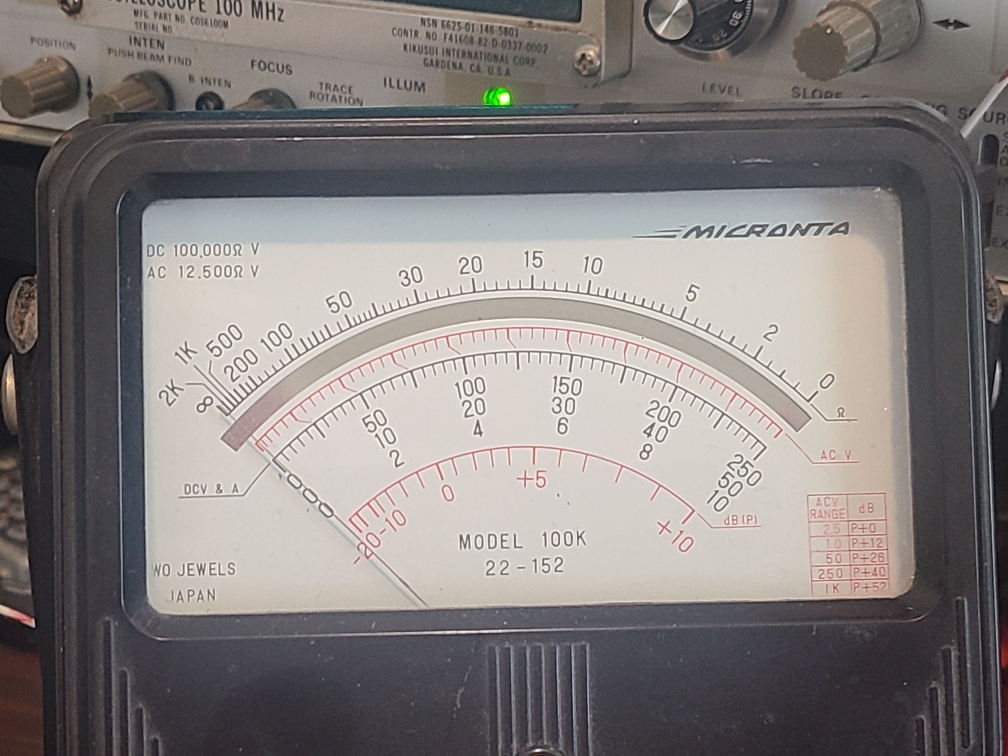
  • Yes, that’s right, there are two (2) kinds of Meters, analog and digital. Shown above is the Radio Shack lookalike to the Simpson 260 VOM which I bought in 1968 because it was cheaper than a Simpson, and said it was more sensitive, 100k Ohms per Volt rather than 20k.

    Voltmeters such as this analog by Radio Shack are made by inserting a large resistor in series with the delicate, in this case, 10 microamp movement. That’s 0.000 010 Amps. For the 10 Volt scale the resistor is (100k Ohms per Volt) one Megohm. 1,000,000 Ohms. Hey, what’s the color code for a 1 Meg resistor. Nevermind, in this case it’s a 1% tolerance with the value printed right on it in English. There’s a bunch of 1% resistors in there, selected one at a time by the function switch.

    Digital meters are another animal. It’s complicated and more than this article can explain. The good news is they’ve gotten really cheap for fairly good ones, and tend to be more accurate than analog. When you want to charge a LiFePo to 14.4 Volts without going over 14.6 because the BMS will disconnect, a digital meter is the thing to have. Let’s compare our meters Thursday.

  • We meet twice a month, 2nd and 4th Thursdays at Scott’s Hamburgers in downtown Bixby, a couple blocks from 151 and Memorial. Go a few blocks East and some South until you see the ARCH pictured above, and then half a block West (toward the setting sun).

    Order at the counter if you like and then head left and into the back room. Program starts promptly at 7PM so come early to order and eat. The club features No Dues, No Business Meeting, and a tech program every month.