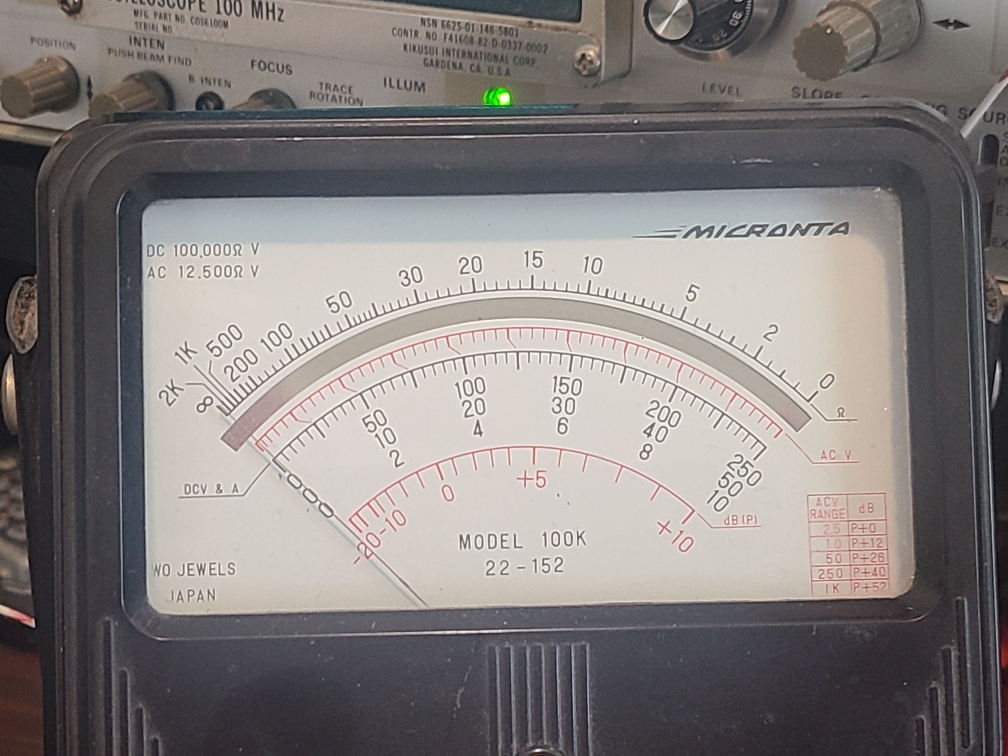
Yes, that’s right, there are two (2) kinds of Meters, analog and digital. Shown above is the Radio Shack lookalike to the Simpson 260 VOM which I bought in 1968 because it was cheaper than a Simpson, and said it was more sensitive, 100k Ohms per Volt rather than 20k.
Voltmeters such as this analog by Radio Shack are made by inserting a large resistor in series with the delicate, in this case, 10 microamp movement. That’s 0.000 010 Amps. For the 10 Volt scale the resistor is (100k Ohms per Volt) one Megohm. 1,000,000 Ohms. Hey, what’s the color code for a 1 Meg resistor. Nevermind, in this case it’s a 1% tolerance with the value printed right on it in English. There’s a bunch of 1% resistors in there, selected one at a time by the function switch.
Digital meters are another animal. It’s complicated and more than this article can explain. The good news is they’ve gotten really cheap for fairly good ones, and tend to be more accurate than analog. When you want to charge a LiFePo to 14.4 Volts without going over 14.6 because the BMS will disconnect, a digital meter is the thing to have. Let’s compare our meters Thursday.
 Radio Society of Greater Bixby
Leave a comment